Are You Ever Too Old to Rap? Hip-Hop Legends Prove Age Is Just a Number in 2024

By: Eddy “Precise” Lamarre

Common at Millennium Park 20 year celebration (Photo credit: Eddy “Precise” Lamarre)

2024 is undoubtedly the year of the rap OG, returning the genre to its essence. At the year’s start, Killer Mike swept the rap category, winning Best Rap Album, Best Rap Song and Best Rap Performance. That accomplishment opened a portal to rap’s golden age. In a time dominated by auto-tune and vibes, younger artists like Travis Scott, Future and Lil Yachty have stamped their distinct styles onto the genre, helping redefine global perceptions of hip-hop culture. The storytelling and lyricism that defined rap in the ’90s seemed lost to history.

2024 has brought a resurgence of what many call “real rap,” and many of rap’s elder statesmen are drawing a line in the sand, reminding the world of their capabilities. Artists who have lived and grown with the genre have delivered projects showcasing their experience and skills. Killer Mike’s “Michael” set the stage, while Masta Ace and DJ Marco Polo followed with “Richmond Hill.” Common and Pete Rock released “The Auditorium Vol. 1,” earning Grammy nominations for Rap Song of the Year and Rap Album of the Year. LL Cool J teamed with Q-Tip for “The Force,” proving hip-hop legends can still innovate.

Other notable releases include Rakim’s “G.O.D’s Network (REB7RTH),” Ghostface Killah’s “Set the Tone (Guns & Roses)” and Ice Cube’s “Man Down.” These projects represent offerings from legends who have spent decades perfecting their craft.

Age and the Evolution of Hip-Hop

This OG takeover has inspired others from the same generation to continue following their dreams and creating new projects. All of this has sparked online debates about whether anyone should be rapping well into their 40s and 50s. Some argue older rappers should step aside and become mentors. Others see no reason for rappers to “age out” of creating their art.

Imagine if the Rolling Stones felt they aged out of rock ‘n’ roll. Rock legends perform and record well into their 70s and are celebrated. Why should rap be different? “Our storytelling gets better with age,” LL Cool J said. Storytelling has always been rap’s core. Who better to reflect on life’s challenges than those who have lived it? Styles have changed, new styles emerged and there’s always space for styles that were popular 20 or 30 years ago.

Hip-hop at 50 points to the culture’s endurance and relevance. Creativity has no expiration date. As Killer Mike said, “I’m going to do this until I physically can’t do it anymore. What you’re hearing now is the perspective of a 48-year-old Black man who has lived enough life to actually have something to say.”

Follow your dream, create your art no matter how old you are. What you have to offer matters, and the world is better for it. Whether you’re a 20-year-old newcomer or a 50-year-old veteran, your voice is valid. Hip-hop, like life, is an ever-evolving journey. These seasoned artists aren’t just making music; they’re showing us how to grow, adapt and stay true to ourselves.

Notable 2024 Releases:

  • Masta Ace and DJ Marco Polo – “Richmond Hill”
  • Common and Pete Rock – “The Auditorium Vol. 1”
  • Rakim – “G.O.D’s Network (REB7RTH)”
  • LL Cool J and Q-Tip – “The Force”
  • Ghostface Killah – “Set the Tone (Guns & Roses)”
  • Eminem – “The Death of Slim Shady”
  • The Dogg Pound – “W.A.W.G. (We All We Got)”
  • MC Lyte – “1 of 1”
  • Ice Cube – “Man Down”

2024 is proving to be a pivotal year for hip-hop, reminding us that age isn’t a limitation but a superpower. These artists are living proof that rapping at 50 is not only possible but essential to the culture they helped build.
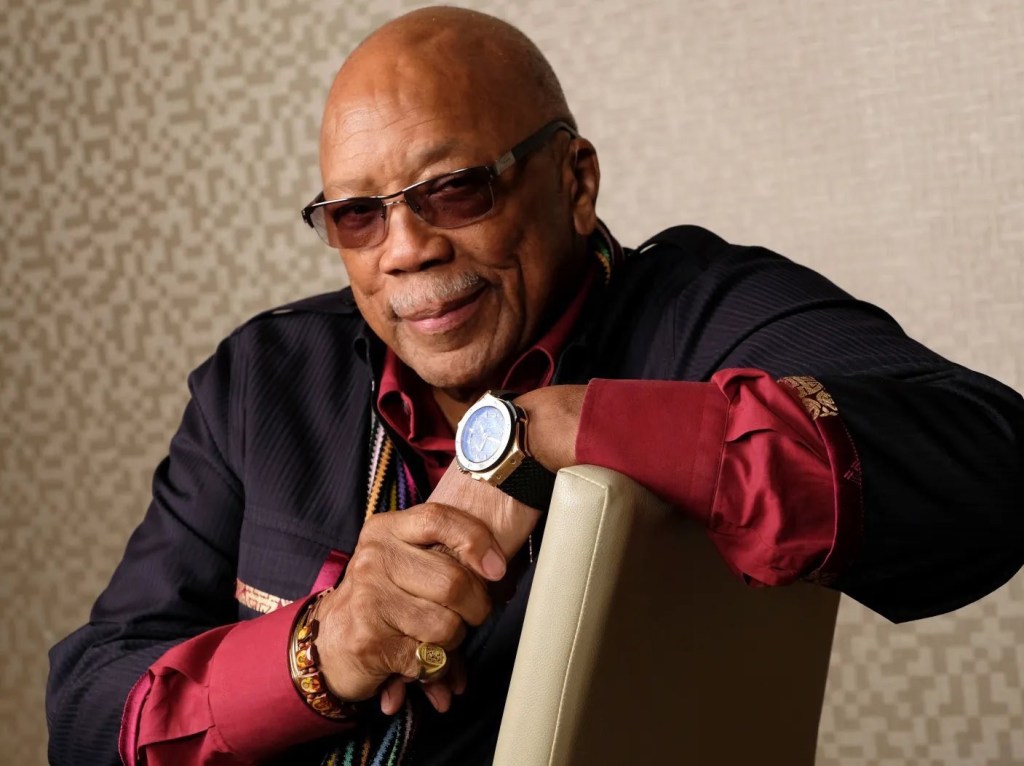

Legendary Music Producer Quincy Jones has died at 91

By: Eddy “Precise” Lamarre

Quincy Jones

Legendary producer Quincy Jones has died at age 91. Jones was a titan in the music industry with a career spanning more than seven decades. His collaborations read like a who’s who of American music.

The South Side of Chicago native, born March 14, 1933 made an impact across multiple musical genres. The 28-time Grammy Award winner remained a mainstay in the entertainment industry.

He began as a jazz musician, touring with Lionel Hampton in 1953 at age 20. After working as a studio musician for Elvis Presley, he toured with Dizzy Gillespie in the Middle East. In 1957, he moved to France and became a music director. He later toured North America and Europe with his 18-person band, the Jones Boys.

In 1961, Jones became the first Black vice president at Mercury Records. Throughout his storied career, Jones worked on nearly 40 major motion picture scores. He produced the iconic “Sanford and Son” theme, and his song “Soul Bossa Nova” became the theme for the blockbuster film “Austin Powers.”

Jones collaborated with Frank Sinatra, Billy Eckstine, Dinah Washington and Sarah Vaughan. He produced the soundtrack for “The Wiz” in 1978 and Michael Jackson’s record-breaking album “Thriller.” His film “The Color Purple” received 11 Academy Award nominations and introduced Whoopi Goldberg and Oprah Winfrey to global audiences.

In 1985, he united music’s biggest stars to perform “We Are the World” to raise money for famine relief in Ethiopia. He leveraged industry relationships to bring artists including Ray Charles, Willie Nelson and Diana Ross together to record the charitable song.

In the 1990s, Quincy Jones Entertainment brought “The Fresh Prince of Bel-Air” to television, launching Will Smith’s career as one of Hollywood’s most successful stars.

Jones recently partnered with Chance the Rapper and Jennifer Hudson to reopen the Ramova Theatre on Chicago’s South Side.

His extraordinary career achievements are too numerous to list completely. His impact on music and entertainment will resonate for generations.

His family shared a statement below.

“Tonight, with full, but broken hearts, we must share the news of our father and brother, Quincy Jones’ passing,” the statement read. “And although this is an incredible loss for our family, we celebrate the great life he lived, and know there will never be another like him. He is truly one of a kind and we will miss him dearly; we take comfort and immense joy in knowing that the love and joy, that were the essence of his being, was shared with the world through all that he created. Through his music and his boundless love, Quincy Jones’ heart will beat for eternity.”

Jones is survived by seven children. Funeral arrangements are pending.

From Cash Money to Cultural Currency: Why Lil Wayne Deserves His Super Bowl Moment

By: Eddy “Precise” Lamarre

Lil Wayne (Photo source: instagram @liltunechi)

New Orleans vibrates with music and has given the world artists who have changed the soundscape. Lil Wayne stands as one of those artists. As jazz notes float through the French Quarter, Wayne’s Lil WeezyAna Fest, founded in 2015, filled the Smoothie King Center with fans and the sounds of a legend. Wayne is a cultural icon and hometown hero, celebrated as such. However, even though he can pack an arena, Wayne will be found standing outside of the Super Bowl as a performer.

Kendrick Lamar being chosen earlier this year as the 2025 Super Bowl halftime performer has caused a stir in the industry for several reasons. The biggest: The game will be held in New Orleans, and many believe Wayne should have been given that opportunity.

Wayne has been a fixture in hip-hop culture since 1991 when he signed to Cash Money Records at age 9, becoming the label’s youngest artist. His signing was the start of a revolution. His years with the Hot Boys laid the foundation for Cash Money, and his solo career would show the world what Wayne was capable of.

The numbers tell the story.

“Tha Block Is Hot” went platinum. “Tha Carter III” moved 1,005,545 copies in its first week and went octuple platinum. “Tha Carter IV” sold 1,184,103 copies in its first two weeks, and “Tha Carter V” crossed the million-unit threshold in sales and streams.

Wayne has 186 entries on Billboard’s Hot 100 and is a five-time Grammy Award winner. The numbers he has amassed are impressive; however, his greatest impact came through his mixtape run. The “Dedication” and “Da Drought” series changed the game, introducing us to Lil Wayne the MC, who recorded these legendary tapes in hotel rooms and tour buses.

Wayne’s influences are hailed by today’s notable artists like Young Thug, who tapped into Wayne’s melodic offerings to create his own style. Kendrick Lamar hails Lil Wayne as his favorite rapper. We also can’t forget to mention that Wayne built Young Money and provided the world with Drake and Nicki Minaj, fundamentally altering hip-hop’s landscape.

Considering Wayne’s global impact, it’s easy to understand why he and many of his fans feel an opportunity was taken from him. Since Roc Nation has been at the helm of the Super Bowl selection process, it has been more rap-friendly, and Lil Wayne would seem like the perfect fit based on his legacy alone.

Wayne hasn’t been without flaws along his journey. In 2020 he was locked up for a firearms charge for which he received a presidential pardon from Donald Trump and he has had some unfavorable and controversial political stances when it comes to Black people. Even during these challenges he managed to stay consistent and provide music to his fans. 

However, on the heels of a fiery battle between Kendrick and Drake, and the smash hit “ Not Like Us” playing at every sporting event and homecoming across the country, one could say Kendrick’s selection was the smart decision.

While many may debate this, one thing that can’t be debated is Lil Wayne’s legacy. On Nov. 2, 2024, at the Smoothie King Center, Mayor LaToya Cantrell and his longtime rival and New Orleans native Master P presented him with a key to the city.

Wayne addressed his thoughts on not performing at the Super Bowl during Lil WeezyAna Fest:

“When the first Super Bowl was here, I made sure I bought tickets at the beginning of the season, and you know I did the same when I moved to Miami. I was wishing my team made it, and guess who made it that year? The Saints,” Wayne said. “I was able to give my mama that suite. She was able to bring my family and other people from New Orleans, and they had a ball. That moment I said to myself, ‘I want to be on stage for the Super Bowl one day in front of my mom.’ And I worked my ass off to get that position, and it was ripped away from me. But this moment right here, they can’t take this away from me.”